
The Disease
MASLD and clinically significant fibrosis — and why F2 changes everything.
What is liver fibrosis, and why does F2 change everything?
Liver fibrosis is the slow, scarred response to chronic injury — a build-up of extracellular matrix that stiffens healthy tissue. It's the common downstream pathology of MASLD, viral hepatitis, and alcohol-related injury. Caught early, it is largely reversible. Caught late, it kills.
Definition
Fibrosis is the excessive accumulation of extracellular matrix proteins — chiefly collagen — in response to repeated hepatocellular injury and inflammation. Over time, scarring distorts the liver's architecture and impairs its function.
The earliest stages (F0–F1) are typically asymptomatic and frequently invisible to routine blood work. By the time signs appear, tissue may already have crossed into advanced fibrosis (F3) or cirrhosis (F4), where damage is structural and largely permanent. Early identification — particularly distinguishing clinically significant fibrosis (≥F2) from milder disease — is the single most consequential decision in the entire care pathway.

No fibrosis
Healthy hepatic architecture; no scarring.
Mild
Portal fibrosis without septa. Asymptomatic.
Significant
Clinically significant fibrosis. Inflection point in risk.
Advanced
Bridging fibrosis. Increasing risk of progression.
Cirrhosis
Irreversible scarring; rising risk of HCC, decompensation, mortality.
Staging system per METAVIR.
Patients are lost between systems, not by science.
The clinical knowledge to detect significant fibrosis exists. What's missing is a system that closes the loop — from incidental finding to confirmatory diagnosis to specialist hand-off — without dropping the patient.
Routine checkup
Risk factors (obesity, T2D, dyslipidemia) are documented but not flagged for hepatic risk.
ALT / AST ordered
Normal results provide false reassurance. Most fibrotic patients have enzymes within range.
Manual hand-off
Referral generated, often by fax. Patient is responsible for booking. No tracking, no closed loop.
Long wait times
6–9 month hepatology backlog. Confusion, delays, and travel barriers cause drop-off.
Often years later
By the time fibrosis is documented, disease has frequently progressed to advanced stages or cirrhosis.
Operational benchmarks aggregated from internal hospital partner data and published primary-care fibrosis screening studies.
The disease moves slowly. Detection moves too late.
Liver fibrosis progresses across decades — but the patient stays asymptomatic until the very end. Once cirrhosis arrives, decompensation and HCC become inevitable for many.
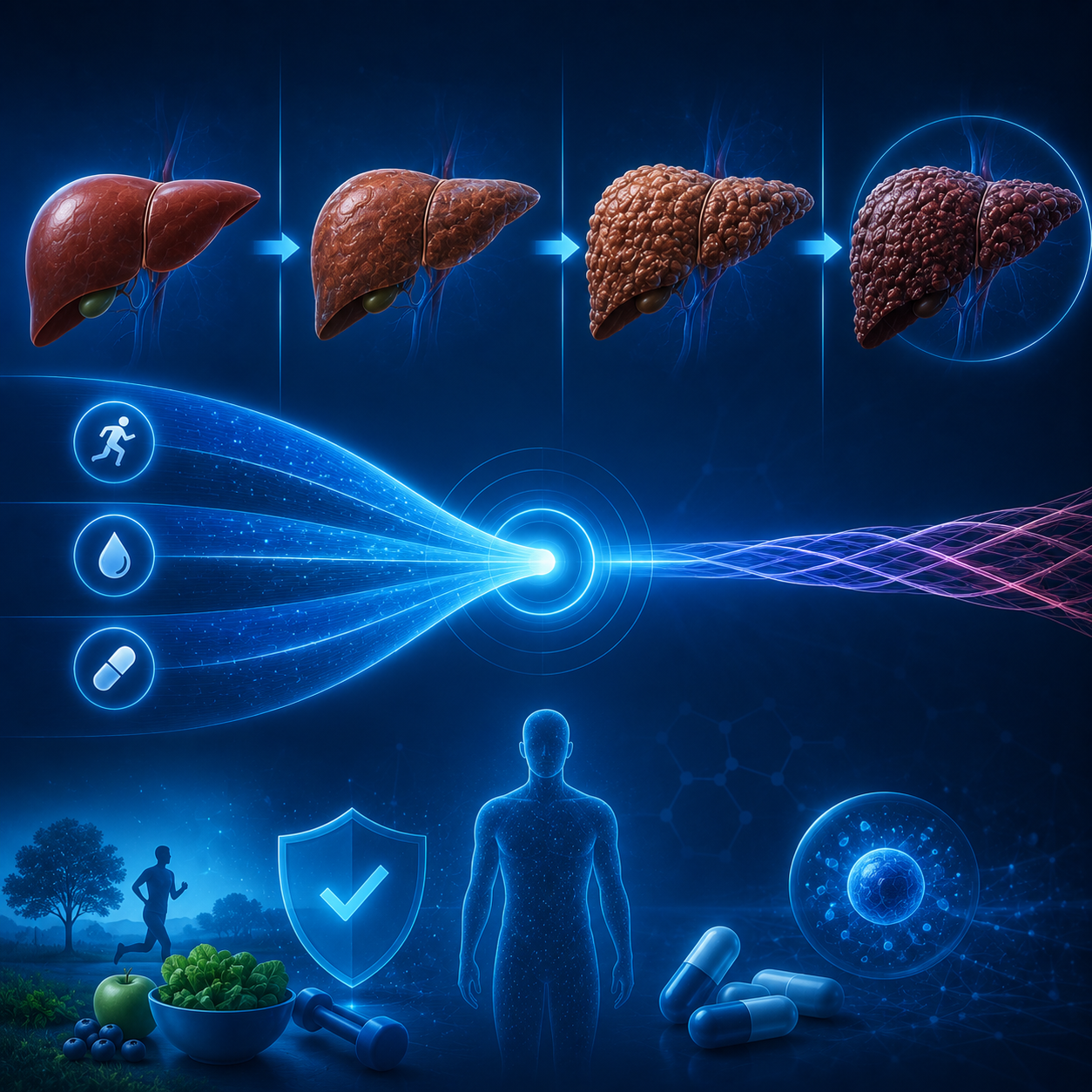
The window for reversal can last more than half a decade. The system rarely uses it.
At F2 and below, lifestyle modification, metabolic risk control, and emerging pharmacotherapy can meaningfully slow — and in many cases reverse — disease trajectory. By F3, fibrosis is bridging. By F4, it is structural. Earlier identification widens the therapeutic aperture.
Fibrosis staging per METAVIR. Natural history per longitudinal MASH cohort studies.
Normal labs, hidden fibrosis.
More than half of patients with significant liver fibrosis present with ALT/AST values within the normal reference range — making traditional enzyme-based screening structurally insufficient.
Advanced fibrosis goes undetected.
A substantial proportion of at-risk patients already harbor F2–F4 fibrosis, yet remain undiagnosed because no systematic pathway exists to look for it in routine care.
FIB-4 was built for cirrhosis.
The FIB-4 calculator was designed for advanced disease and exhibits limited sensitivity for F2 fibrosis at population-screening scale — leaving an actionable cohort invisible.